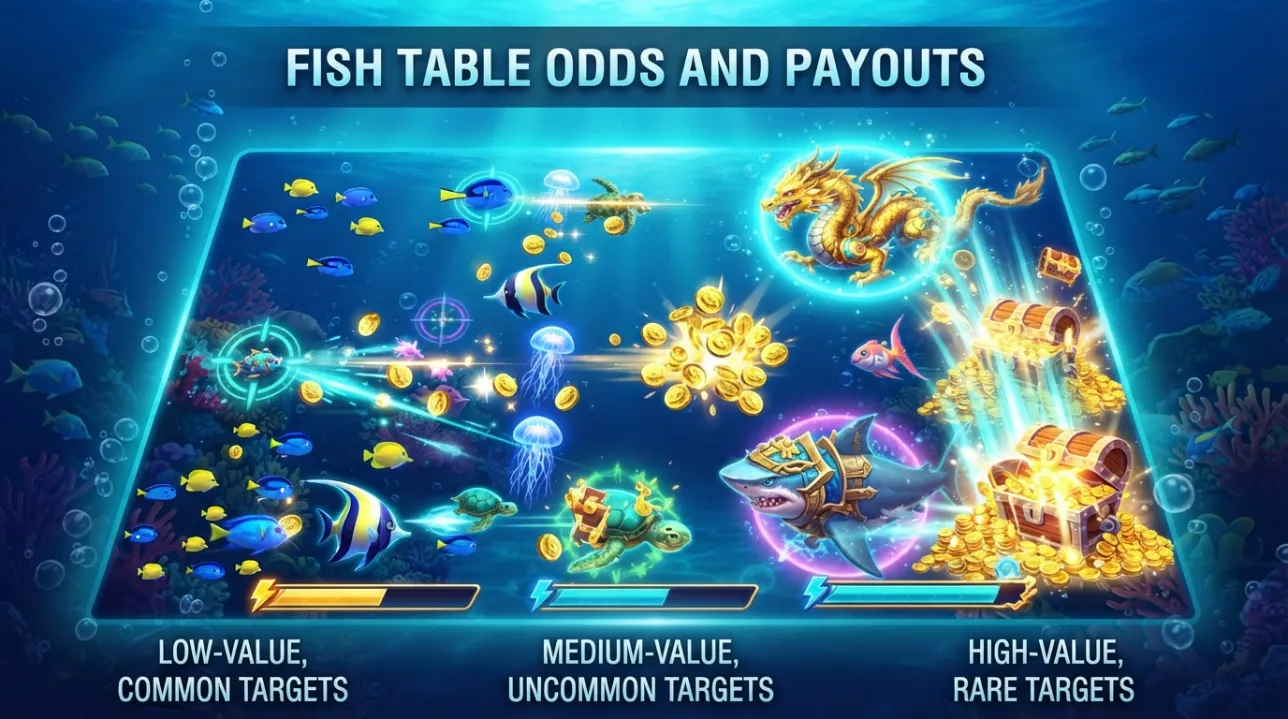
Fish table games mix a real skill element, your aim and timing, with an underlying math model that decides how often each fish actually pays out. If you are new to the format, our overview of what a fish arcade game is and how it works covers the basics. Understanding the math, not just your reflexes, is what separates a player who reads the game correctly from one who is only reacting to flashy animations.
Key Takeaways
- Every fish table game is built on Return to Player (RTP), the theoretical percentage of all wagered coins a game pays back over the long run.
- A Random Number Generator (RNG) decides whether a shot successfully hits and scores, independent of your previous shots.
- Your aim and timing affect how many shots you take and which targets you attempt, but not the underlying hit probability itself.
- Independent testing labs such as eCOGRA and iTech Labs certify that a game’s actual results match its published RTP.
- Higher value fish are typically programmed with a lower hit probability, which is what keeps their payout in balance with common, low value fish.
What Does RTP Mean in a Fish Table Game?
Return to Player, or RTP, is the percentage of every coin wagered across a game’s entire lifetime that is mathematically designed to come back to players as winnings, calculated by dividing total payouts by total amount wagered. An RTP of 95 percent means that, over an enormous number of shots, the game is designed to pay out 95 dollars for every 100 dollars wagered.
According to independent testing lab eCOGRA, this is described as theoretical RTP, the built in design target, which is different from the actual RTP any single player experiences in one short session. A single session can run well above or below that long run number simply due to normal statistical variance.
How Does the Random Number Generator Decide Each Shot?
A Random Number Generator, or RNG, is the software component that determines the outcome of every individual shot the instant you fire, independent of any shot that came before it. This is why two players aiming at the exact same fish, at the exact same moment, can get completely different results.
The RNG does not track a pattern, build toward a payout, or “owe” you a hit after a string of misses. Independent labs such as eCOGRA and iTech Labs test these generators by running simulated play at massive scale to confirm the distribution of outcomes matches what the game claims, and that no bias exists in either direction.
Why Do Bigger Fish Pay Out Less Often Than Small Ones?
Bigger, rarer fish are typically programmed with a lower hit probability specifically because their point value is so much higher. If a dragon or boss style fish paid out at the same rate as a small common fish, the game’s overall RTP would spiral far past its designed target.
This tradeoff is the same principle behind a progressive jackpot slot, where a massive prize is balanced by odds so long that most players never land it. In a fish table, this shows up as high value targets that clearly take more shots, and more coins, to bring down on average, which is by design rather than a glitch or bad luck streak.
Does Skill Actually Change Your Odds of Winning?
Skill changes how efficiently you spend your coins, not the underlying probability the RNG assigns to any given shot. Better aim and timing mean fewer wasted shots at fish you were unlikely to hit, and smarter target selection means you are consistently firing at fish whose payout justifies their difficulty.
In that sense, fish table games sit in a hybrid category. The math behind each shot is pure probability, exactly like a slot reel, but the decision of what to shoot at, and when, is a real skill layer sitting on top of that math. Players who study a game’s fish value chart tend to make more efficient decisions than those simply shooting at whatever crosses the screen.
This theme is covered further in our roundup of practical fish table strategies.
How Can You Tell if a Fish Table Game Is Actually Fair?
Look for a published RTP figure and a certification mark from a recognized independent testing lab, commonly eCOGRA, iTech Labs, or BMM Testlabs, usually listed in the game’s information screen or the platform’s help section. A certified RNG is tested specifically to confirm it cannot be manipulated by the platform or predicted by the player.
If a platform cannot point you to any published RTP or third party certification for its fish table titles, that is a reasonable signal to treat the game with more caution, since fairness testing is standard practice among established operators. Our roundup of fish table games you can try for free is a reasonable starting point for comparing titles.
Frequently Asked Questions
What Is a Typical RTP Range for Fish Table Games?
Standard online slot style games commonly carry an RTP around 95 to 96 percent, though the exact figure varies by title and operator, so it is worth checking the specific game’s published number rather than assuming an industry average applies.
Can a Fish Table Game Be Rigged to Avoid Big Payouts?
A properly certified fish table game cannot be adjusted mid session by the operator, since its RNG and payout tables are locked and independently tested, which is exactly why third party certification from a lab such as eCOGRA matters when you are choosing where to play.
Does Shooting Faster Increase My Chances of Hitting a Fish?
No, firing rate does not change the RNG’s underlying hit probability for any individual shot, though faster, more accurate aim does let you attempt more efficient shots within a session, which is a skill factor rather than a change to the math itself.
Why Do I Sometimes Lose Many Shots in a Row on the Same Fish?
Short losing streaks are a normal, expected outcome of RNG based probability and do not indicate the game is broken, since actual RTP only converges toward its theoretical target over a very large number of shots, not within a single short session.
Is RTP the Same Thing as House Edge?
No, house edge is the mirror image of RTP. A game with a 95 percent RTP has a 5 percent house edge, meaning that percentage of total wagers is retained by the platform over the long run rather than paid back to players.
What Does Volatility Mean in a Fish Table Game?
Volatility describes how spread out a game’s wins are rather than how large they are on average. A low volatility fish table pays smaller amounts more often, while a high volatility one pays out less frequently but with larger individual hits, and two games can share the same RTP while feeling completely different session to session.
Disclaimer
This article is for general informational and educational purposes only and explains commonly published industry concepts such as RTP and RNG certification. It does not guarantee the odds, payout behavior, or certification status of any specific game or platform, which can vary and change over time.