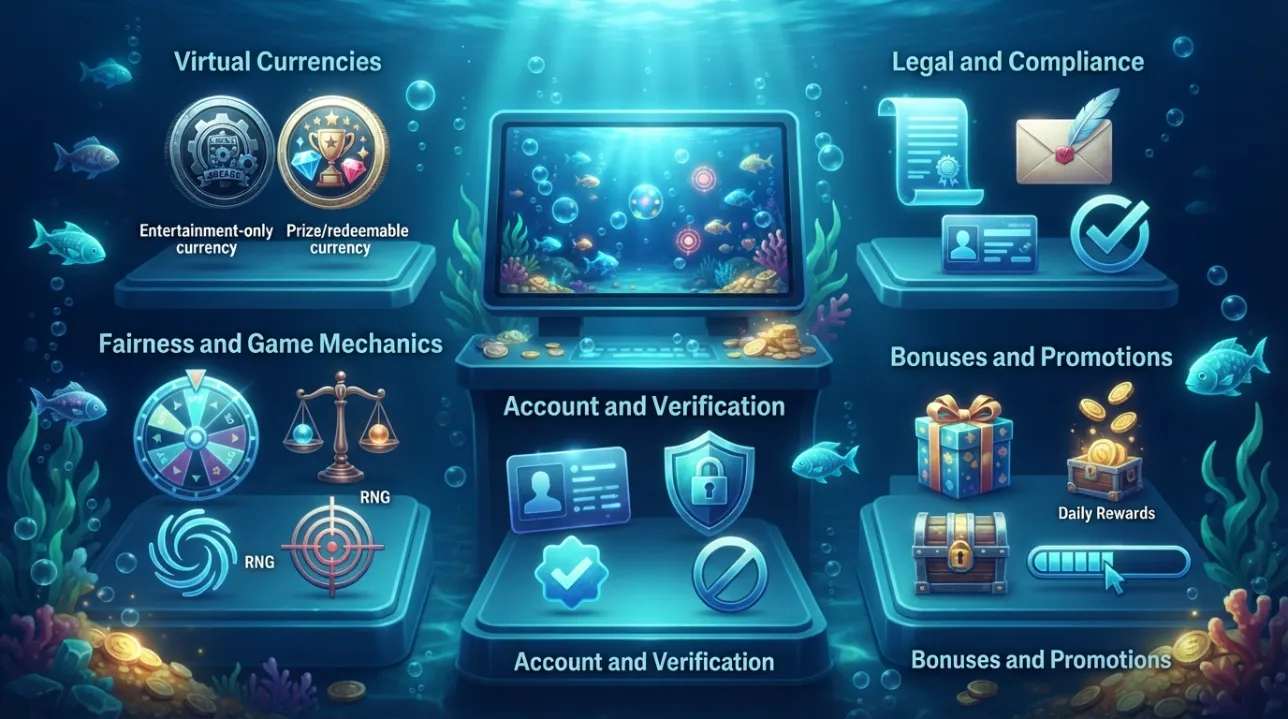
Fish table and sweepstakes casino platforms come with their own vocabulary, and a lot of confusion online starts with players mixing up terms that actually mean very different things. This glossary walks through the terms you will run into most often, in plain language, so you can read any platform’s rules with real confidence.
Key Takeaways
- Gold Coins and Sweeps Coins are not interchangeable, only Sweeps Coins can ever be redeemed for a real prize.
- No Purchase Necessary is a legal requirement, not a marketing slogan, and every legitimate sweepstakes platform must offer it.
- RTP and RNG describe the math and technology behind a game’s fairness, not a promise about any single session.
- Terms like AMOE and redemption threshold come directly from sweepstakes law, not casual industry slang.
- Knowing these terms helps you compare platforms accurately instead of relying on marketing language alone.
What Do the Core Currency Terms Mean?
Gold Coins are the entertainment currency on a sweepstakes casino platform, purchasable with real money and usable to play games, but never redeemable for cash or prizes under any circumstance, no matter how large a win looks on screen.
Sweeps Coins are the second currency on the same platforms, earned for free through a qualifying method or received as a bonus with a Gold Coin purchase, and they are the only balance that can be redeemed for real prizes once you reach a platform’s minimum threshold. Our full breakdown of how Sweeps Coins work walks through this in more detail.
Redemption Threshold is the minimum number of Sweeps Coins a platform requires before it will process a cash out request, and this number is set individually by each operator and disclosed in its official rules.
What Do the Legal and Compliance Terms Mean?
No Purchase Necessary is the legal principle that a sweepstakes must offer a way to enter, and to win, without paying anything, which is the entire foundation that lets sweepstakes casinos operate outside traditional gambling law in most states.
Alternative Method of Entry, usually shortened to AMOE, is the specific free method a platform provides to satisfy the No Purchase Necessary requirement, commonly a mail in request, a daily login bonus, or a social media entry form.
According to legal industry coverage from Mondaq, regulators require this free method to give entrants a genuinely equal chance at the same prizes as someone who made a purchase, not a token alternative buried in fine print.
Consideration is the legal term for anything of value a player would have to give up to enter, and removing consideration entirely, by keeping a real free entry path available, is what keeps a sweepstakes model out of lottery and gambling regulation. See our state by state sweepstakes casino legality guide for how this plays out across the US.
What Do the Gameplay and Fairness Terms Mean?
Return to Player, or RTP, is the percentage of total wagers a game is mathematically designed to pay back to players over its entire lifetime, expressed as a figure such as 95 percent.
Random Number Generator, or RNG, is the certified software system that determines the outcome of each individual shot or spin independently, with no memory of previous results and no way for a player or operator to predict or influence it in real time.
House Edge is the percentage of wagers a platform is mathematically designed to retain, and it is simply the mirror image of RTP, so a 95 percent RTP game carries a 5 percent house edge.
Volatility describes how a game’s wins are distributed rather than their average size, with low volatility games paying smaller amounts more often and high volatility games paying less often but with larger individual hits.
What Do the Platform and Account Terms Mean?
Self Exclusion is an account setting that lets a player voluntarily lock themselves out of a platform for a chosen period, from a short cooling off window to a permanent ban, as a responsible gaming safeguard.
Deposit Limit is a cap a player or platform sets on how many Gold Coins can be purchased within a given day, week, or month, used as a budgeting and responsible gaming tool.
Know Your Customer, usually shortened to KYC, is the identity verification process a platform runs before releasing a real prize redemption, typically requiring a government issued ID, to confirm the person redeeming coins is who they claim to be and meets the platform’s age and location requirements.
Tournament and Leaderboard refer to a competitive event mode where players compete for ranked prizes over a set window rather than playing independently, a format explained in more detail in our guide to how fish table tournaments and leaderboards work.
What Do Common Bonus and Promotion Terms Mean?
No Deposit Bonus refers to free Sweeps Coins or Gold Coins a platform gives a new account without requiring any purchase first, typically used as a welcome offer or as part of a platform’s required free entry method.
Daily Bonus is a recurring free coin amount, often Sweeps Coins, credited to an account once per day simply for logging in, which commonly doubles as part of a platform’s no purchase necessary entry system.
Wagering Requirement, sometimes seen on bonus coin offers, is a rule requiring a player to play through a bonus a set number of times before any resulting Sweeps Coins become eligible for redemption, and the exact multiplier is always disclosed in a platform’s promotion terms.
Frequently Asked Questions
What Is the Difference Between Gold Coins and Sweeps Coins?
Gold Coins are for entertainment only and can never be redeemed for cash, while Sweeps Coins are the sweepstakes prize currency that can be redeemed for real money or gift cards once you reach a platform’s minimum threshold.
Is No Purchase Necessary Just a Legal Loophole?
No, it is a genuine legal requirement enforced by the Federal Trade Commission and state regulators, meaning a platform must provide a real, comparably fair free entry method, not a symbolic one, or it risks being reclassified as an illegal lottery.
Does a Higher RTP Always Mean Better Odds for Me Personally?
A higher RTP means a better long run design target across all players combined, but it does not guarantee a better result in any single session you personally play, since short term outcomes are still governed by normal statistical variance.
Why Do Platforms Require KYC Before Paying Out a Prize?
KYC verification confirms a redeeming player’s identity, age, and location, which protects the platform from fraud and helps ensure prizes are only paid to eligible players under the platform’s own official rules and applicable state law.
Is AMOE Only Used by Sweepstakes Casinos?
No, Alternative Method of Entry is a broader sweepstakes law concept used across many types of promotions, from retail giveaways to sweepstakes casinos, anywhere a sponsor wants to offer a purchase based entry alongside a free one.
Disclaimer
This glossary is for general informational and educational purposes only and reflects commonly used industry terminology as of publication. It does not constitute legal or financial advice, and specific definitions, thresholds, and requirements can vary by platform, state, and over time, so always confirm exact terms in a platform’s official rules.