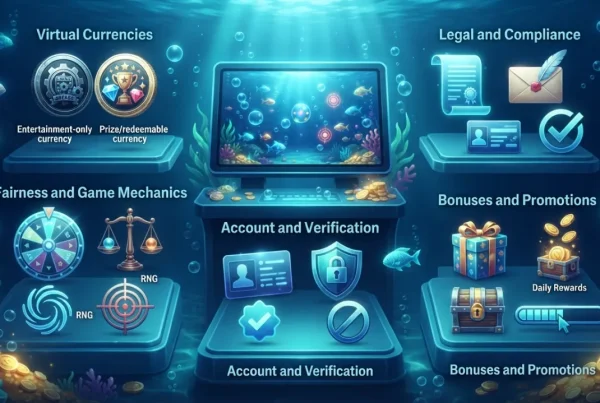
A legit fish table casino is open about who runs it, how you can play for free, and how prizes get paid. Fake or sloppy sites usually fail at least one of those checks. This guide shows you eight signs of a trustworthy platform and the red flags that should make you walk away.
Most fish table casino sites in the U.S. run as sweepstakes casinos. That means you play with virtual coins and can redeem certain winnings for prizes. The model is legal in many states, but not in all of them. So trust matters more here than on a typical game site.
Key Takeaways
- A legit fish table casino names its company, posts clear rules, and offers a free way to get Sweeps Coins.
- Real sites check your ID before they pay a prize, and they never charge a fee to release winnings.
- State laws change fast, so confirm that the site serves your state before you play.
- Treat any site that rushes you, hides its rules, or asks for a fee as a red flag.

What Is a Fish Table Casino Site?
A fish table casino site is a website or app where you shoot fish and sea creatures to earn points or coins. Most U.S. sites use a two-coin system. Gold Coins are for fun only. Sweeps Coins can be redeemed for prizes once you meet the site’s rules. If this is new to you, start with our guide on how Sweeps Coins work or the glossary of fish table terms.
The legal picture keeps shifting, so a site that works in one state may be blocked in another. For example, Casino Beats reports that California made sweepstakes casinos illegal as of January 1, 2026. Our state-by-state legality guide covers the details.

How Can You Tell If a Fish Table Casino Is Legit?
Look for eight signs. One sign alone proves little. However, a site that passes most of them is far more likely to be trustworthy.
1. The Company Is Named and Reachable
Scroll to the footer first. You should see a legal company name, a mailing address, and a way to contact support. If you cannot find these, that is a problem, because anonymous sites are hard to hold responsible.
2. The Rules Explain a Free Way to Play
Legal sweepstakes must offer an alternative method of entry, often called AMOE. This is usually a mail-in request that earns free Sweeps Coins. In fact, an RTM legal blog explains that promotions that require a purchase and offer no free route are treated as lotteries. So a missing AMOE is a serious warning.
3. Redemption Rules Are Clear
Good sites tell you the minimum balance, the payout methods, and the usual wait time before you play. In contrast, vague terms are a warning sign. For more on timing, read our guide to sweepstakes casino payouts.
4. The Site Verifies Your Identity
Legit sites ask for ID before they pay a prize. This step can feel slow, but it protects against fraud and underage play. Independent reviewers often list ID and address proof as a standard redemption step. A site that skips it deserves extra doubt.
5. Games Show Fair-Play Information
Fish games run on a math model and a random number generator. Trustworthy sites explain how their games work and name independent testing labs. Industry standards such as GLI-19 include requirements for random number generators. You can also ask a lab to confirm a certificate. Our guide to fish table odds and payouts explains what to look for.
6. Responsible Gaming Tools Are Easy to Find
Look for purchase limits, time-out tools, and self-exclusion. A good site also lists a help line. The National Council on Problem Gambling adopted 1-800-MY-RESET in January 2026 as the National Problem Gambling Helpline number. See our responsible gaming guide for tips on setting limits.
7. The Site Is Honest About Where It Works
A trustworthy platform lists the states it does not serve and blocks sign-ups from those places. If a site lets anyone in with no checks, it may cut corners elsewhere. Compare its state list with a tracker of state sweepstakes rules, or see our guide to casino laws by state.
8. Support Is Real and the Track Record Is Consistent
Test support before you play. First, ask a simple question about redemption and see how fast and clear the answer is. Then search for recent player reports. Also look for patterns, not one angry post.

What Are the Red Flags of a Fake Fish Table Casino?
A fake or risky site often asks for money before it pays, or it hides how it works. Watch for these red flags:
- A fee to release a prize. The FTC says real prizes are free, and anyone who asks for “taxes” or “processing fees” to hand over a prize is a scammer.
- Guaranteed wins. No fish game can promise a payout.
- No free entry method. If the rules never mention a mail-in or free option, walk away.
- Pressure to act now. The FTC also warns that scammers rush you so you cannot think.
- Hard-to-trace payment methods. Be careful with gift cards, wire transfers, or crypto-only requests.
- Moving goalposts. Terms that change after you win, or payouts stuck in “pending” for weeks, are bad signs.
- Support that vanishes. If nobody answers before you win, nobody will answer after.

Quick Checklist: Green Flags vs. Red Flags
| Check | Green flag | Red flag |
|---|---|---|
| Company info | Legal name, address, and contact page | Nothing in the footer |
| Free entry | Mail-in method in the rules | No free option listed |
| Redemption | Minimums and timelines stated | Vague or changing terms |
| ID checks | Required before payout | Skipped or optional |
| Fees | No fee to release prizes | Fee, tax, or “processing charge” |
| State access | Restricted states are blocked | Open to everyone |

What Should You Do Before You Sign Up?
Take five minutes to run through these steps:
- Confirm that your state is allowed.
- Read the sweepstakes rules and find the free entry method.
- Check the redemption minimum, ID needs, and wait times.
- Ask support one simple question and note the reply.
- Set a time limit and a spending limit. Our guide on funding your account safely can help.
Next, read our guide to a fish table no deposit bonus so you know what a fair starter offer looks like.
Frequently Asked Questions
Is a fish table casino the same as a real-money casino?
No. Most U.S. fish table casino sites use a sweepstakes model with Gold Coins and Sweeps Coins. Licensed real-money online casinos follow a different legal path and exist in only some states. Our guide to sweepstakes vs. social casinos explains the gap.
Can a legit site still stop serving my state?
Yes. Laws change, and operators may leave a state after a new ban. If that happens, read the site’s rules to see how it handles balances and redemptions.
Where can I report a fish table casino scam?
Report it at ReportFraud.ftc.gov and contact your state attorney general. AARP also suggests reporting to the FBI’s IC3 at IC3.gov.
Do legit sites ever ask me to pay to receive a prize?
No. A legit site may sell optional coin packs, but it should never charge a fee to release prize winnings. According to the FTC, if you must pay to get a prize, it is a scam.
Want to see how fish games play before you pick a site? Browse the fish table games on Fish Game Arcade and learn the basics first.
Disclaimer
This article is for general information only. It is not legal, tax, or financial advice. Sweepstakes and gaming laws change often, so check your state’s current rules. Players must meet each site’s age rule, and no result is guaranteed. If gambling stops feeling like fun, call or text the National Problem Gambling Helpline at 1-800-MY-RESET.
Sources
- Casino Beats: California bans sweepstakes casinos as Newsom signs AB 831
- Gambling.com: Sweepstakes casino legal states tracker
- RTM: No Purchase Necessary laws and your sweepstakes
- FTC Consumer Alerts: Don’t pay to get a prize
- Thespike: Stake.us sweepstakes rules and redemption
- GLI-19 Standards for Interactive Gaming Systems, v3.0
- National Council on Problem Gambling: 1-800-MY-RESET announcement
- AARP: Warning signs of sweepstakes and lottery scams